If you’ve ever filled a glass from your Pasco County tap and squinted at it suspiciously, you’re not alone. We hear the same questions almost every week from homeowners in New Port Richey, Trinity, Hudson, and Port Richey — Is this water actually safe? Why do my dishes have white spots? Should I be filtering it?
The short answer: yes, Pasco County’s municipal water is safe to drink by EPA standards. But “safe” and “ideal” aren’t the same thing — and if you’re on a private well in Hudson or Brooksville, the rules change completely. Here’s the honest, plumber’s-eye breakdown of what’s actually coming out of your tap, where it comes from, and when it makes sense to filter, soften, or install reverse osmosis.
The short answer (yes, with caveats)
Pasco County Utilities delivers water that meets every federal Safe Drinking Water Act standard. The county publishes an annual Water Quality Report showing routine testing for bacteria, lead, nitrates, and a long list of regulated contaminants — and it consistently passes.
But “EPA-safe” leaves out a few things that matter a lot to homeowners:
- Hardness. Pasco water is genuinely hard — the limestone aquifer beneath us sees to that.
- Chlorine and chloramine. Used for disinfection. Safe, but they affect taste and smell.
- Aesthetic minerals. Iron, sulfur, and trace metals that aren’t regulated but show up in your fixtures and laundry.
- What happens between the treatment plant and your tap. Older pipes, hot water tanks, and home plumbing add their own variables.
So the water leaving the plant? Solid. The water reaching your glass after traveling through 1970s galvanized pipes in a Holiday neighborhood? That’s a different conversation.
Where Pasco County tap water actually comes from
Pasco County draws from the Floridan Aquifer — a massive underground limestone system that supplies most of central and west Florida. Water filters down through the limestone over decades before being pumped up, treated, and distributed.
That limestone path is exactly why your water is hard. As water moves through limestone, it picks up calcium and magnesium minerals. By the time it reaches the treatment plant, those minerals are already there — and standard municipal treatment doesn’t remove them, because they’re not technically contaminants.
Pasco County Utilities runs the water through filtration, disinfection (typically chloramine), and pH balancing before sending it out through the distribution system. It’s a well-run system. But it’s still hard water.
Hardness levels — why your dishes have spots
Most Pasco County tap water tests between 150 and 250 parts per million (ppm) of total hardness. Anything over 121 ppm is officially classified as “hard,” and anything over 180 ppm is “very hard.”
For context: Trinity homes — which sit closer to the limestone-heavy ridge — frequently test on the higher end, sometimes pushing 250-300 ppm. New Port Richey and Port Richey homes typically come in slightly lower but still firmly in the “hard” range.
Here’s what that hardness costs you in everyday wear and tear:
- White spots on dishes and glassware. Calcium deposits left behind as water evaporates.
- Soap that won’t lather. Hard water and soap don’t get along.
- Crusty buildup on faucets and showerheads. Scale that takes vinegar (or replacement) to remove.
- Shorter appliance life. Water heaters, dishwashers, and washing machines all run shorter lives in hard-water areas — typically 20-40% shorter without treatment.
- Skin and hair dryness. Hard water doesn’t rinse soap and shampoo cleanly.
None of this is unsafe to drink. It’s just expensive over time and a daily nuisance.
What’s tested and regulated (and what’s not)
The EPA sets enforceable limits on about 90 contaminants in municipal drinking water — things like:
| Regulated | Tested in Pasco | Notes |
| Lead | Yes | Pasco generally tests well below the 15 ppb action level |
| Coliform bacteria | Yes | Routinely passes |
| Nitrates | Yes | Within limits |
| Disinfection byproducts | Yes | Within limits |
| Arsenic | Yes | Within limits |
But there’s a long list of things municipal water doesn’t routinely test for — or doesn’t have to meet strict limits on:
- PFAS (“forever chemicals”) — relatively new on the federal radar, limited testing data for Pasco specifically
- Pharmaceutical residues — generally low but not zero
- Microplastics — not regulated
- Hardness, iron, sulfur — aesthetic only, not health-regulated
If you want to know what’s actually in your specific home’s water, a professional water test is the only way to find out for sure. Pasco County’s published report tells you what’s in the system on average — not what’s coming out of your kitchen tap after it’s traveled through your home’s pipes and water heater.
Private well water in Hudson, Brooksville & rural Pasco
If you’re on well water — common in Hudson, Brooksville, Spring Hill, and rural parts of north Pasco — the rules are completely different.
Nobody is testing your water but you. The EPA’s Safe Drinking Water Act doesn’t apply to private wells. Florida regulates the initial well installation, but ongoing water quality is the homeowner’s responsibility.
Hudson well water in particular has a reputation for five specific issues:
- High iron content — rust-colored stains in toilets, sinks, and laundry
- Sulfur (rotten egg smell) — usually hydrogen sulfide from the aquifer
- Bacterial contamination risk — especially in shallow wells or after heavy rain
- Sediment — fine particles that wear out fixtures
- Hardness — often even higher than municipal water in the same region
If your home runs on a well, you should be testing annually at minimum. We test free for any homeowner in our service area — that’s not a sales pitch, it’s just how we like to start the conversation.
When you should test your water (and how)
You should consider a water test if you notice any of these:
- White or yellow buildup on fixtures and shower doors
- A metallic, salty, or rotten-egg smell or taste
- Stains in toilets, tubs, or laundry (red/orange = iron, blue/green = copper)
- Skin irritation or dry hair after showering
- Hot water that smells worse than cold water (typically anode-rod sulfide reaction)
- Visible cloudiness or sediment in a clear glass
- New home purchase, especially if older or on a well
- Pregnancy or infant in the household
- You haven’t tested in over 2 years
You can buy a home test kit for $15-$30 that’ll give you a baseline on hardness, pH, and chlorine. For anything beyond that — heavy metals, bacteria, PFAS — you need a certified lab test. We bring testing equipment to your home, run a full panel on the spot, and walk you through what the numbers actually mean.
Filter, soften, or RO — what fits your situation
Here’s where most homeowners get confused, because the marketing in this industry is genuinely terrible. Three completely different systems get sold as solutions to “bad water,” and they each do something different.
| System | What It Does | Best For | Typical Cost (Installed) |
| Whole-house carbon filter | Removes chlorine, taste, smell, some sediment | Homes with chlorine taste, light filtration needs | $800 – $1,800 |
| Water softener | Removes calcium and magnesium hardness | Homes with hard water (most Pasco homes) | $1,000 – $3,500 |
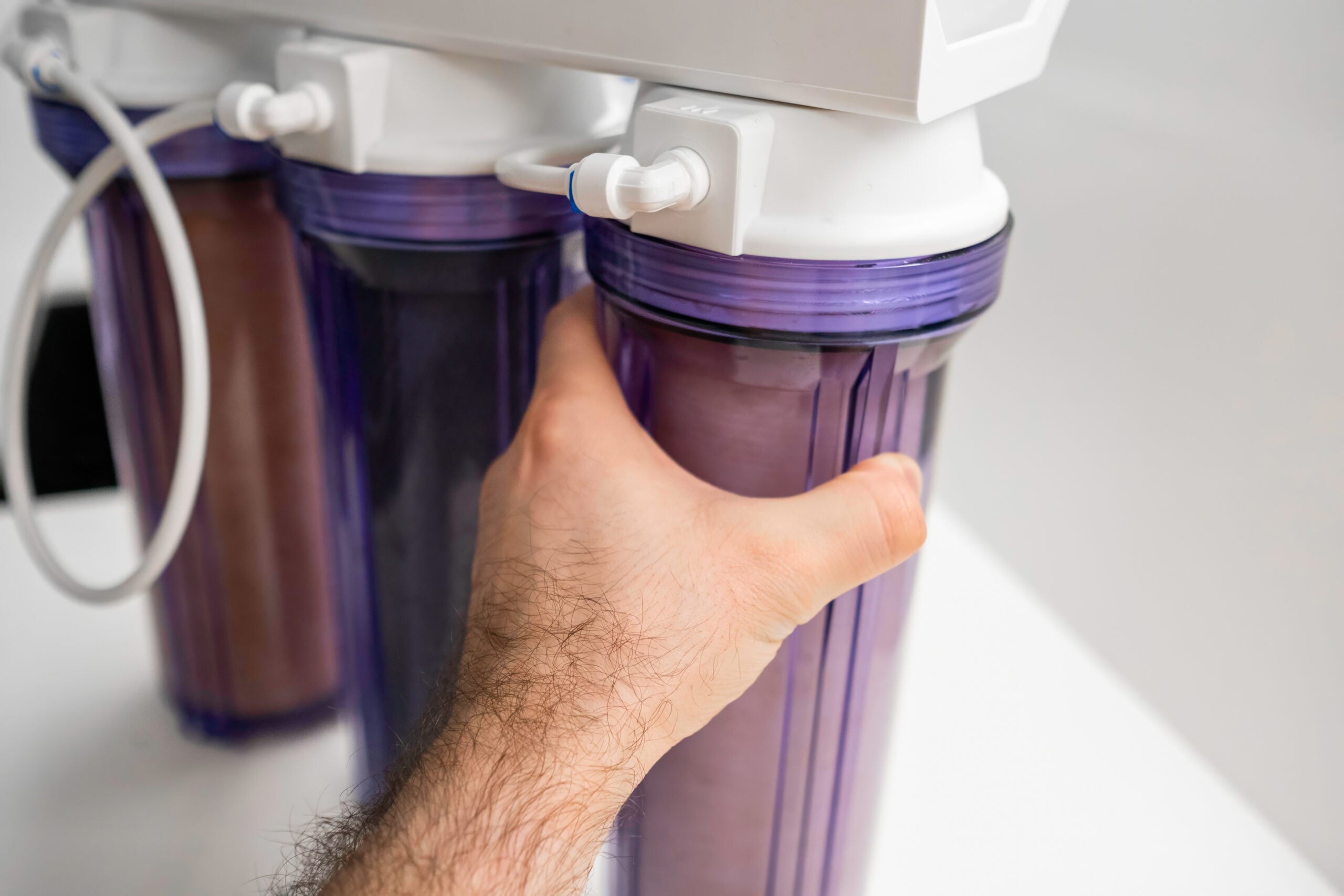
| Reverse osmosis (under-sink) | Removes nearly everything — lead, PFAS, fluoride, salts, contaminants | Drinking and cooking water quality | $300 – $1,500 |
| Whole-house RO | Same as above, but for entire home | High contamination wells, max purity demand | $4,000 – $10,000+ |
| Iron / sulfur filter | Specifically removes iron and hydrogen sulfide | Most Hudson + rural well homes | $1,500 – $3,500 |
A water softener and a reverse osmosis system solve completely different problems. Softeners protect your plumbing and appliances. RO gives you cleaner drinking water. Most Pasco County homes benefit from both — a whole-house softener plus an under-sink RO at the kitchen tap. That combination runs about $1,500-$3,500 installed and covers 90% of what most families actually need.
The Compass take: what we recommend for NPR-area homes
After installing systems in hundreds of homes across New Port Richey, Trinity, Port Richey, Hudson, and Holiday, here’s the honest pattern we see:
- Municipal water homes (NPR, Port Richey, most of central Pasco): A water softener handles 80% of the daily quality-of-life issues. Add an under-sink RO at the kitchen sink for drinking and cooking water — done.
- Trinity homes (higher hardness from limestone ridge): Same setup, but size the softener properly — many Trinity homes need a higher-capacity unit than a standard 3-bedroom recommendation.
- Hudson well water homes: Iron filter + softener + UV disinfection is the typical combination. RO at the kitchen tap if you want bottled-quality drinking water.
- Brooksville/rural Pasco: Test first — well water out here varies dramatically house to house. We’ve seen perfect wells and we’ve seen wells that need a full multi-stage treatment train.
The wrong move is buying a softener at a big-box store and installing it yourself before knowing what’s actually in your water. The right move is testing first, then sizing the system to your specific water and household.
Frequently asked questions
Is Pasco County tap water safe to drink without filtering? Yes — it meets every federal safety standard. Filtering improves taste, removes chlorine, and addresses aesthetic concerns, but it isn’t required for safety.
Why does my water smell like rotten eggs? Usually hydrogen sulfide, especially common in Hudson and well-water homes. If it’s only in your hot water, the anode rod in your water heater is the likely culprit — that’s a $200-$400 fix.
Do I need a water softener if I have city water in Pasco County? Most homeowners benefit from one. Pasco’s municipal water is hard enough (150-250+ ppm) that you’ll see scale buildup, shorter appliance life, and soap-rinse issues without one. Not required for safety, but worthwhile for plumbing longevity.
How much does a water test cost? A basic at-home test kit runs $15-$30. A professional in-home test from us is free — we come out, test on the spot, and walk you through the results. No pressure to buy anything.
Is well water in Hudson safe to drink? Sometimes — but it depends entirely on the specific well. Annual testing is the only way to know. We test free for Hudson-area homeowners.
Should I install whole-house reverse osmosis? For most Pasco homes, no. An under-sink RO at the kitchen tap covers drinking and cooking — which is where water purity matters most. Whole-house RO is overkill (and expensive) unless you have a specific contamination issue.
Get your water tested — free, no pressure
If you’re tired of guessing what’s in your water, we’ll come out and tell you exactly what’s there. Compass Plumbing tests Pasco, Hernando, and Hillsborough County homes for free, and we explain the results in plain English — not a sales pitch.
Call (727) 717-0590 or request service online. Licensed Florida plumber (CFC1433099), 5-star rated, family-owned right here in New Port Richey.
Why this beats the competition: Most plumbers in Pasco County don’t publish water quality breakdowns at all — they want you to call before you understand the problem. We’d rather you read this, run a home test kit, and call us when you actually know what you’re dealing with. Informed homeowners make better decisions, and better decisions mean longer-lasting plumbing.
Related reading
- Compass Plumbing — Water Treatment Services
- Water Testing in New Port Richey, FL
- How Much Does a Water Softener Cost in Florida? ({{PLACEHOLDER — Brief #9, publishing Jun 30, 2026}})